
Public Speaking as an Educator
I am an educator who practices public speaking. Maybe you are too. Or maybe it’s something you do only occasionally as a part of your professional role, for example, during parent-teacher conferences or in staff meetings. Even if you don’t think of yourself as a speaker, we are always communicating with others. The way you connect with families at school drop-off and pickup times, or when you have to get aligned on classroom practices with your co-teacher—all of this requires a thoughtful approach to communication. Or maybe you are a school leader who sits on a school board, facilitates professional learning for your staff, and presents your vision to families and stakeholders. Speaking is probably something you cannot avoid.
I thought it might be helpful to share my process around every talk I give and why I take so much time preparing then executing every presentation, whether they are in-person or virtual.
I have said this before… I never thought public speaking would be a part of my job, but here we are…
How I got started:
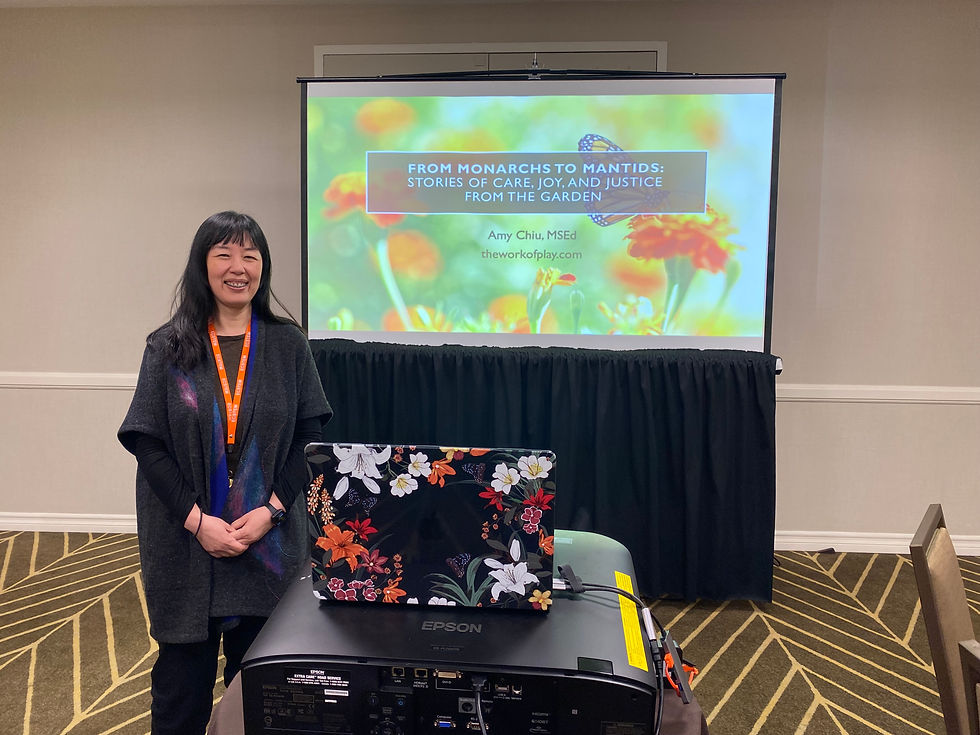
Years ago, I was hired as a preschool teacher at a school where teachers were expected to both perform and present regularly in front of others. That first year, I did everything from performing a musical number onstage while flying a toy plane through the air to presenting to families and staff on a variety of ECE topics. This was the culture of the school—at once creative, artsy, and devoted to early learning—and the staff reflected that. Being introverted but also a team player, I did many things out of my comfort zone that year to support the school’s mission. Over time, this got easier as I continued to put in the reps speaking in front of an audience.
The middle part:
Fast forward some years, and I was hired at a job to develop educational products for children. This was new territory for me as the job required more business skills, one of which was clear and concise communication with overseas vendors. I learned very quickly to adapt my tendency to be wordy and flowery to communicate concisely and precisely with folks for whom English was a second language. This job honed my thinking and doing so that I was more able to craft messages tailored for specific audiences. This has enhanced my writing and iteration process as I now ruthlessly cut out parts that sound clever but clunky. I avoid jargon and try very hard to distill complex ideas into simple words. Simplicity is quite hard to achieve!
During the pandemic, I was at yet another job. I felt really isolated and was craving in-real-life interaction with others. When the world was opening up again I saw an opportunity and submitted a proposal for a conference. I was thrilled when it was accepted because I was eager to connect with other educators and feel that community again. It made me realize that every opportunity to speak was a chance to connect with my peers, and that helped me to shift from feeling anxious about speaking to excited to give back to my field.
Some of you know my burnout story and how that was the catalyst to more speaking engagements. I started facilitating professional development at schools and saw that it was making an impact. Schools often asked me to return and over time I built a reputation for being someone that helped teachers to feel seen and supported. Not only that, I could support administrators by taking professional learning off their full plates. I aim to be the person who isn’t only dependable and professional but also easy to work with. While I have a suite of topics I regularly speak about, I enjoy shaping each session for my intended audience and their specific pain points. Every talk is a chance to refine my work and communication so that it can better reach the people I am there to help.

Now:
I am finishing up my second year of teaching college and have built stamina by lecturing regularly in front of students. I have led parenting classes which has helped me to practice communicating with a different kind of audience. Sometimes I am a guest on podcasts and webinars. I have learned the power of sharing stories as a way to engage folks’ heart before I ask any more of them. I feel less imposter syndrome and more confident taking up space with my body and voice, but this takes a lot of effort and discipline. Here are some things I do regularly to improve as a speaker:
Watch a lot of YouTube videos so I can hone in on how other speakers do it: I take notes on how speakers come on stage, begin their talk, how they move around and all of their non-verbals including facial expression, eye contact, gestures, and body posture. I notice their pacing, how they add intentional pauses, and how they add vocal variety to emphasize certain points. I note how they add humor and how they tell stories. I see how they take the audience on a satisfying arc, activating engagement and emotion so the audience feels inside the content and not merely receiving it. I will watch short and long talks, panels and fireside chats, webinars and video podcasts.
Record myself for later review: This part isn’t easy to do, but is very valuable once I got over being self-conscious. I will ask others to record me speaking or I will set up my phone and record myself. Yes, sometimes it would be painful to watch and I would literally cringe and hyper fixate on what I wasn’t doing right. But I have also learned that I’m a harsher critic than most so I try not to stress about perfection. The audience isn’t looking for perfection, but authenticity, so a little hiccup here and there isn’t devastating. Things that have improved since I started watching myself speak include better posture (I tend to push by belly out and slump my shoulders), less fidgeting (which can be very distracting), and less rushing (because I practice speaking at an intentional pace).
Follow speakers on social media: There are so many free resources out there and speakers who are willing to share their knowledge and methods. They also talk about the business of speaking which is a necessary consideration. Though many teachers aren’t comfortable talking money (is this one reason why we are historically under-compensated?) I know that I must be thoughtful about both the art and business of speaking. I am not going through burnout again so I now focus on quality over quantity. It’s scary to set prices, but I have to believe that I am worth it and I always aim to overdeliver for my partners. Seeing how other speakers build their career is helpful in this regard. Though I regularly speak for free, I have mouths to feed! And I’m teaching my own kids about entrepreneurship which is valuable in a creator economy.
Read widely and connect to other sectors and disciplines: Though it’s challenging to get through a book, as evidenced by the pile of unfinished books next to me, I read constantly. I scroll my LinkedIn feed, read research, all kinds of books, and online forums. Reading widely enhances my perspective and thinking and helps me to surface interesting connections and insights. I also listen to audio books which is like listening to someone speak.
Write for different purposes: Reading and writing go hand in hand. For a time, I felt pressure to produce content for social media but that started to zap my energy. I no longer chase algorithms and metrics though I still love engaging with folks’ posts and comments. Writing has always been a comfort and a joy, and I want to send nourishing words out into the world without worrying about how others might receive them. Since AI is homogenizing writing, it is even more important now to develop and share our unique voice.
Regular self-reflection: Public speaking is a real fear for many, and I get it! I still get nervous and I still feel imposter syndrome. Normally, I prefer to be behind the scenes, so I have to give myself pep talks and encouragement to continue getting up in front of people. I remind myself I am modeling a growth mindset, and that every challenge is an opportunity to grow and learn. I focus on incremental improvement and try to be patient about progress. I reflect on how a talk went and how I can improve it for the next time. Most importantly, I remember I speak in service of children, families, and educators. This last thought helps me to get out of my head into a more giving and generous space.

A note on crafting the slide deck:
I build my deck depending on the purpose of the talk. When it’s a keynote-type speech, I aim for fewer slides with strong visuals and few words. When it’s a practical workshop, I create more slides so I can be more detailed with practical information. When a slide has a lot of words, I make sure to animate different sections so I can bring up one line at a time to be less visually overwhelming. My decks range from 10-30 slides.
My visual style is minimalist with a pop of color. I use Canva to build my slides, and I have set my brand fonts and colors so it’s consistent across all of my decks but still curated for my audience. For example, I might use more cute graphics with preschool educators and less fluff for my elementary educators. I used to put my contact info on the last slide, with QR codes that take folks right to my website and socials, but sometimes people leave early so they might miss that part. So, I have started to put the QR code to my website on my opening slide to encourage engagement from the start.
A week before:
Let me share how I dress for speaking engagements. At this stage in my life, comfort is paramount. I tend to dress in solid neutral colors which emphasize my philosophy of slowness and nature. That could be a brown knit top with navy pants, for example. I also think about whether I might be asked to wear a lapel mic which would be clipped to my top so I have to consider where that might be placed. I wear sneakers so I can stand comfortably. They are more fashion sneakers than athletic ones. Having an outfit ready to go helps me to feel less stress leading up to the event. The goal is to feel comfortable and confident. I don’t wear jewelry but if I did I would keep it minimal because it can be noisy which will detract from the talk.
At home, I will record myself one more time giving the talk all the way through, standing up as I would at the event. Then, I will review this video as I’m walking on the treadmill at the gym. This is the final opportunity to refine any details before I give the talk. The day before, I try to relax and not overdo or overthink. By this time, I have confirmed all details with the event organizer so that I feel prepared logistically.
Day of event:
We have come to the day of the event! Hopefully, I have gotten a good night’s sleep. I make sure I have my usual protein-rich breakfast to start the day off with good energy. I always pack a snack and a water bottle, just in case. I make sure I arrive to the event earlier than expected, at least 30 minutes ahead of schedule. The last thing I want is to feel rushed.
When I arrive, and because I have buffer time, I will sit somewhere quiet and do a body scan. This is a time for me to slow down and connect to what my body is feeling. I notice and name any sensation, such as, “I am feeling nervous and excited. I have butterflies in my belly. Let me take deep breaths and remind myself I am okay and that today will be a wonderful day. I get to talk to educators about children and learning!” Once again, I remind myself I do this in service of children, families, and educators so I am less self-conscious.

Afterwards:
It is not uncommon for me to feel sick and depleted after a speaking engagement. I often wonder whether I had been feeling ill all along and just kept pushing through, or that the social energy and requirement to be “on” for an extended time is felt in my body as emptiness and fatigue, even if only temporary. Because crashing after an event is common, I try to schedule time to decompress the day after the event. I also dive deep into self-reflection, although I admit this initial reflection tends to be critical as I ruminate on all of my mistakes—stumbling over words, omitting thoughts, and dissecting every line—whether they landed or fell flat, at least from my point of view. Even if I got a recording of my speech, I often can’t bear to watch it until much later. One time I waited a whole year before I felt brave enough to watch myself speak. But the recording is there for when I am ready.
Another thing I do after a talk is email the event coordinators to send my congratulations and well wishes. I have an inkling how hard they have worked to realize their vision for this event, and I want them to know how much they are appreciated. I also ask for feedback and/or testimonials at this time so I can continue improving my work and output. Then, an invitation to continue our collaboration should it be mutually beneficial and aligned. The goal is to nurture and extend relationships in order to be more impactful in affecting positive change. The best partnerships I have are ones that have been grown over time and deepened through ongoing collaboration.

Final Thoughts:
Public speaking has become an extension of my work and mission in supporting the field of early childhood education. Though it doesn’t come naturally, I treat speaking like the essential communication skill that it is and practice deliberately and regularly. I acknowledge and accept that feeling of imposter syndrome, and then I do it anyway. I remind myself that I am here to serve others and advocate for our field. For me, influence and persuasion begin with tapping into an audience’s emotions rather than only using logic to defend my positioning. Connection is my anchor, and I aim to be both a bridge and a lighthouse for others seeking clarity around who they are as educators and caregivers.
If you are an educator who speaks or is curious about speaking, please reach out! Let me know your thoughts and questions in the comments and let’s be a support for one another. We are stronger in community, so let’s amplify our impact by pooling our knowledge and strategies. Speak up because your perspective and lived experiences matter. Speak out because children are a vulnerable population and they need us as advocates.


Comments